Spanish jarred pasta sauce brand, €240,000 of weekly sales, deciding whether to match a rival's four-week 25% promotion.
This case picks up where the discount week left off. The same composite brand: Spanish jarred pasta sauces, about 98,000 jars and €240,000 of retail sales a week, an average shelf price of €2.45 and a gross margin of 40%.
The question
Six weeks after the April discount, the competitor announced a bigger move: 25% off its whole range at both major chains, for four weeks in June. The brand now had a measured number for what the competitor's price does to its volume, and the next question was the obvious one.
"If we match their 25% for the same four weeks, do we come out ahead?"
What the file looked like
The same 156 weeks of scanner data, read from the other side. Over three years the brand had run 22 promotional weeks of its own, at depths between 10% and 30%, with feature and display recorded separately. Each promotion had several ordinary weeks after it in the file, which matters, because a promotion's real effect includes the weeks afterwards, when shoppers who stocked up do not buy.
What the analysis did
Promo Elasticity fits volume against promotion depth, holding price, seasonality and distribution, and then subtracts pull-forward: the dip in the following weeks caused by shoppers who bought early rather than bought more.
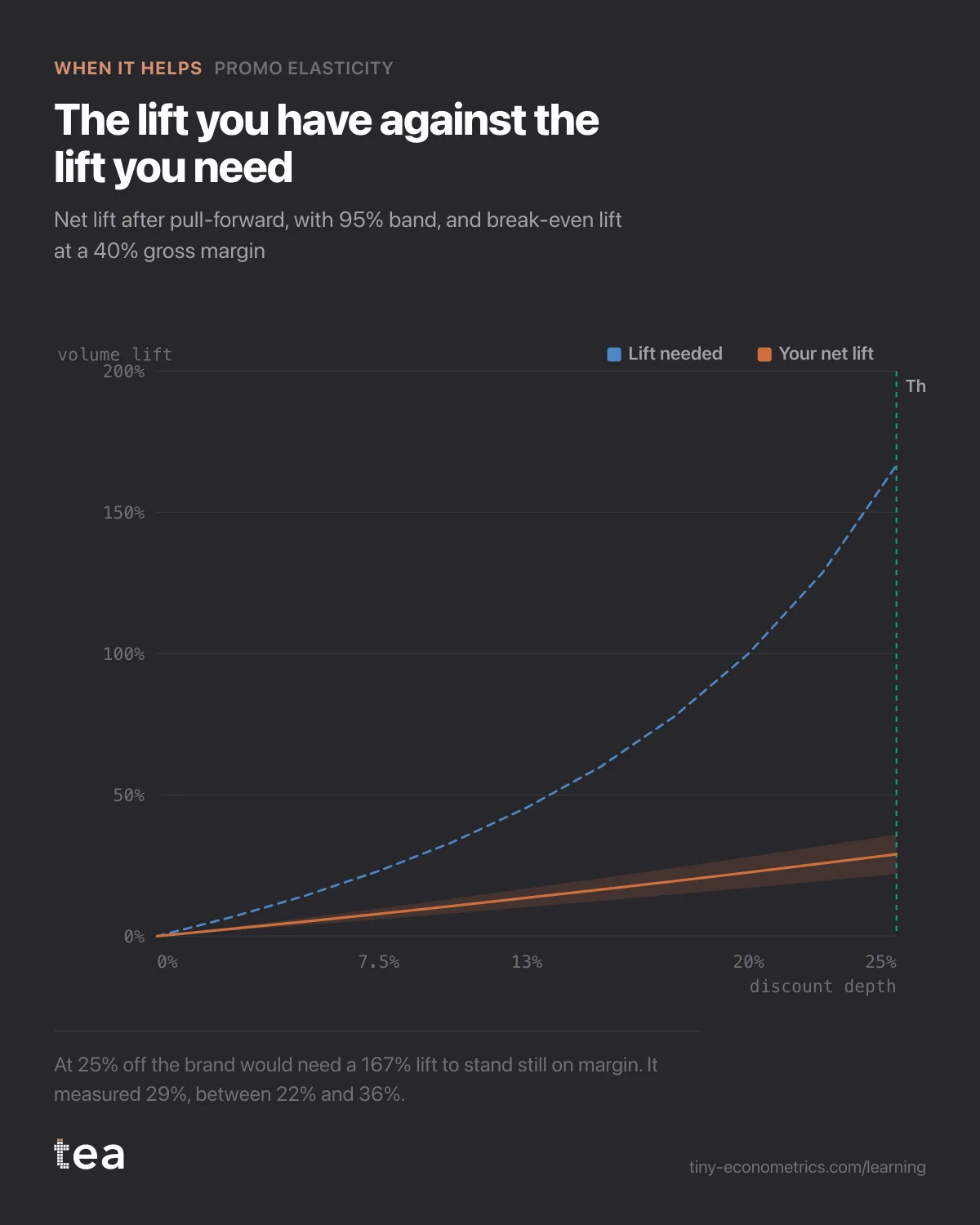
At 25% off, the gross lift in the promoted weeks was 41%. The post-promotion dip, spread over the next three weeks, gave back the equivalent of 12 points. The net lift, the volume that would not otherwise have been sold, was 29%, with a 95% interval from 22% to 36%.
That is a respectable promotion. Pasta sauce responds to price, and the own-price elasticity of -1.35 had already said so. The question is not whether the promotion moves volume. It is whether it moves enough volume to pay for the margin it gives away.
Here the arithmetic is unforgiving. At full price the brand keeps 40 cents of every euro. At 25% off it keeps 15 cents of every original euro, because the whole discount comes out of margin. To make the same gross margin, a 25% promotion has to sell 2.67 times the normal volume: a lift of 167%. The measured net lift was 29%.
The verdict: hold
The analysis helped, and it gave the commercial meeting a number rather than a reflex. Per promotional week, at the brand's own measured lift and margin:
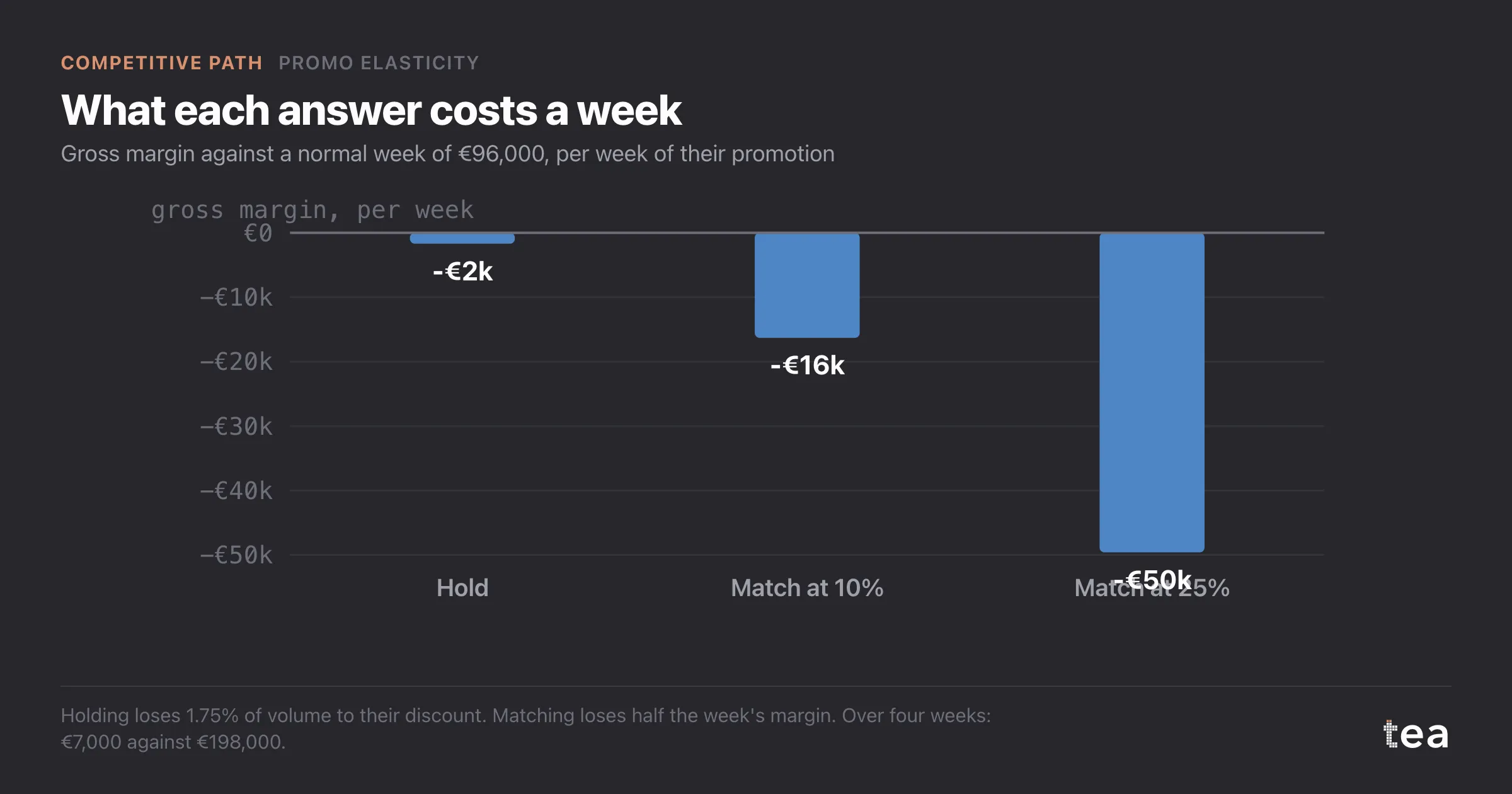
- Hold. At the cross-elasticity of 0.07, their 25% takes about 1.75% of our volume. That costs about €1,700 of gross margin a week.
- Match at 25%. Volume rises by 29% net, but each jar now earns 15 cents of margin per original euro instead of 40. Gross margin falls from €96,000 to about €46,400 a week, a cost of roughly €49,600.
- A shallower answer at 10%. Net lift about 11%, margin about €79,700 a week: a cost of about €16,300. Still almost ten times the cost of holding.
Over four weeks, matching would have spent around €198,000 of margin to protect around €7,000. Even at the top of the lift interval, 36%, the match loses about €47,000 a week. There is no plausible reading of the data under which matching pays.
The brand held its price for June. When the four weeks closed, volume was 1.6% below what the model expected without the competitor's promotion, inside the 0.8% to 2.8% range the cross-elasticity interval had implied. The cost was what the model said it would be, and it was small.
Two caveats travel with the result. The lift is the brand's own average across 22 promotions, and a 25% depth with heavier display could do better than average, though nothing in the file suggests anywhere near 167%. And the calculation is gross margin at the brand's level. If the retailer funds part of the discount, the break-even falls, and the arithmetic should be rerun with the real funding split.
The lesson
Matching a competitor's discount is a promotion like any other, and it has to clear the same bar: the lift you can measure against the margin you give away. When their move takes a little and your answer would give away a lot, the cheapest response is to do nothing, deliberately. This is the last step of the Competitive Path, and it is usually the one that ends the meeting.
tea, the product
Your file, this question
Fifteen analyses on a CSV of weekly data, with the intervals and the diagnostics shown, and a plain sentence when the data cannot answer. Free while in beta, by invitation.
Request a place in the beta→tea, the product
Fifteen econometric analyses on your own CSV: Promo Elasticity, saturation curves, elasticities, budget allocation. Intervals and diagnostics shown, and a plain sentence when the file cannot answer.
Free while in beta, by invitation.
Request a place in the beta →Liked this? Run it on your own data.
tea runs Promo Elasticity and fourteen other analyses on any weekly CSV, in minutes. Free while in beta, by invitation.
The Competitive Story
- Excess share of voice: where a challenger brand actually gained
- Share of voice when your monitoring service misses digital spend
- Competitor discount week: 2.1% of our volume, not the feared 8%
- A new entrant after ten weeks: too few to measure cross-elasticity
- Should we match a competitor's 25% discount? Lift, margin, hold
- Promotions that always coincide with the rival's cannot be split (out October 25, 2026)
- A lost share point, decomposed: their media, their price, our season (out October 30, 2026)