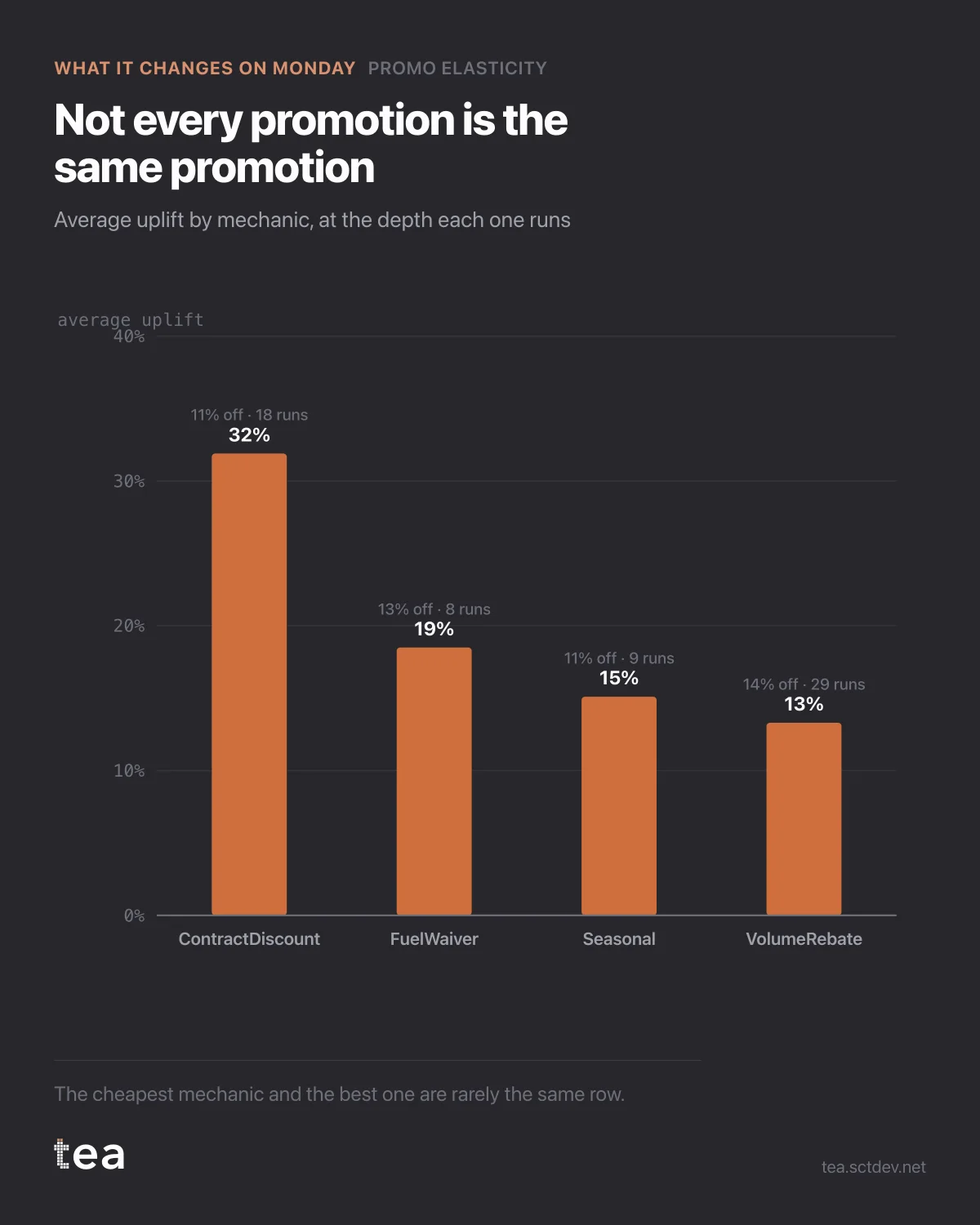
Four promotional mechanics, four different results, and they are not ranked the way the calendar funds them.
Contract discount: 31.9% average uplift, at 11.2% depth, over 18 runs. Fuel waiver: 18.5% uplift at 13.1% depth, 8 runs. Seasonal: 15.1% at 11.1% depth, 9 runs. Volume rebate: 13.3% at 13.5% depth, 29 runs.
Read the first and the last rows together. Contract discount gives away less and returns more than twice as much. Volume rebate gives away the most, returns the least, and runs more often than everything else combined.
That is not a subtle inefficiency. It is the most used mechanic in the business being the worst one in it.
How this happens, in any company, without anyone making a bad decision:
The mechanic that is easiest to execute gets used most. A rebate needs no negotiation and no approval, so it runs by default, and default is a powerful force in a promotional calendar.
Each individual run reports a positive uplift, so nothing ever fails. Thirteen percent more volume is a number you can put in a review, and nobody compares it against the alternative mechanic that was never run that week.
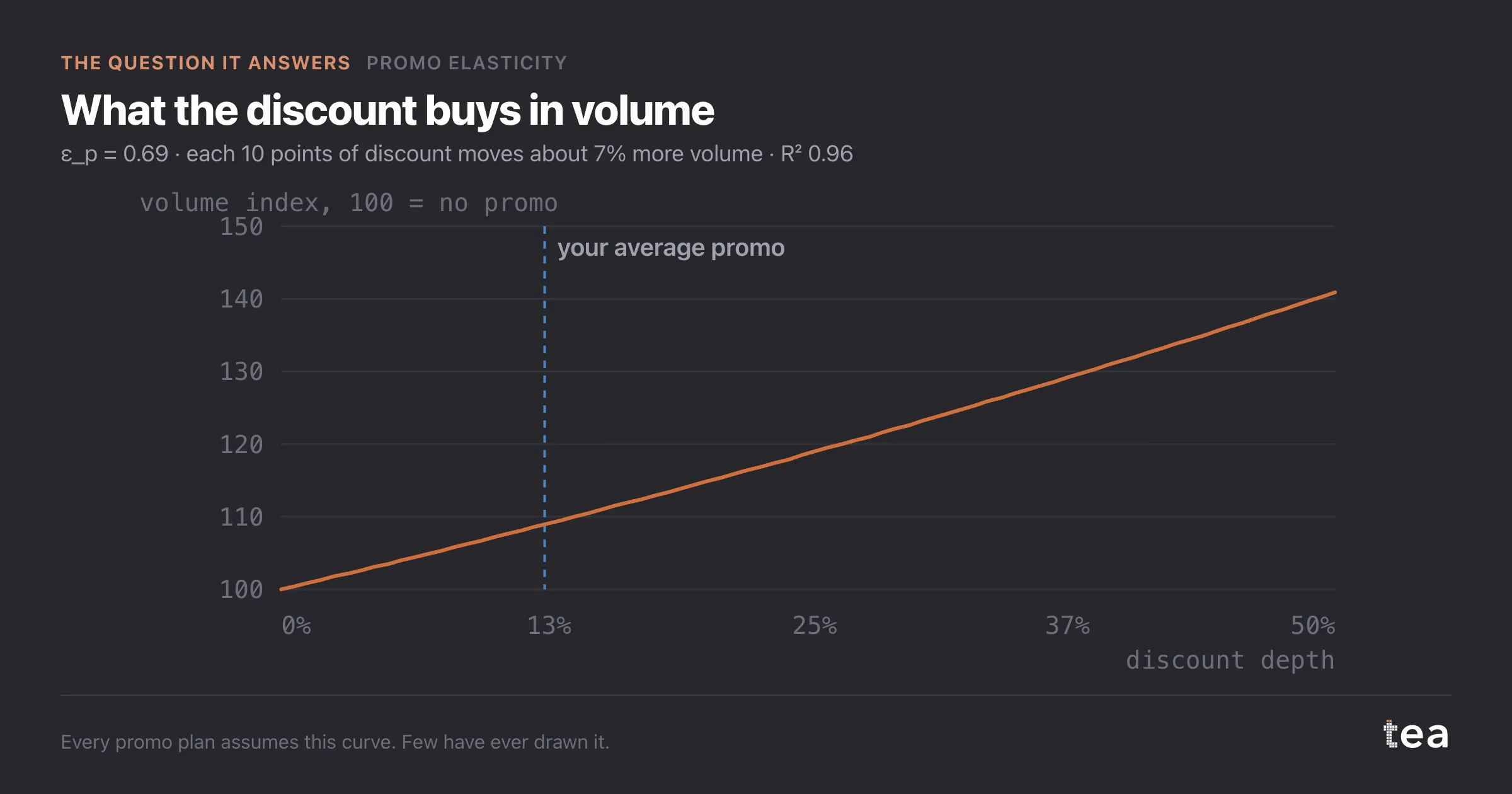
And the depth is chosen by precedent rather than by response. All four here sit between 11% and 14%, which tells you the depth is a convention rather than a decision.
What to do with it on Monday: take the two mechanics with the strongest response, hold their depth where it is, and move runs from the weak mechanic into them rather than adding new activity. Nothing about the budget changes, only which lever is pulled.
And put the depths under review. On this business the honest version of the whole analysis is that promotional depth is expensive and the uplift is smaller than it costs. Fewer, sharper, better chosen is a plan the data supports. More of the same is a plan the data actively argues against.
A caveat on the counts, because they matter as much as the percentages. Fuel waiver has run eight times and seasonal nine. Those estimates are built on very few events, and the difference between 18.5% and 15.1% on that evidence is not something to reorganise a calendar around.
Contract discount at 18 runs and volume rebate at 29 are the two rows with enough behind them to act on, and conveniently they are the two that matter, being the best and the most used.
The general habit: before moving money between mechanics, check how many times each one has actually run. A promotional plan built on single examples is a plan built on anecdotes with decimal points.
The chart is the actual output of Promo Elasticity in TEA, run on a sample file anyone can download.
tea, the product
Your file, this question
Fifteen analyses on a CSV of weekly data, with the intervals and the diagnostics shown, and a plain sentence when the data cannot answer. Free while in beta, by invitation.
Request a place in the beta→tea, the product
Fifteen econometric analyses on your own CSV: Promo Elasticity, saturation curves, elasticities, budget allocation. Intervals and diagnostics shown, and a plain sentence when the file cannot answer.
Free while in beta, by invitation.
Request a place in the beta →Liked this? Run it on your own data.
tea runs Promo Elasticity and fourteen other analyses on any weekly CSV, in minutes. Free while in beta, by invitation.