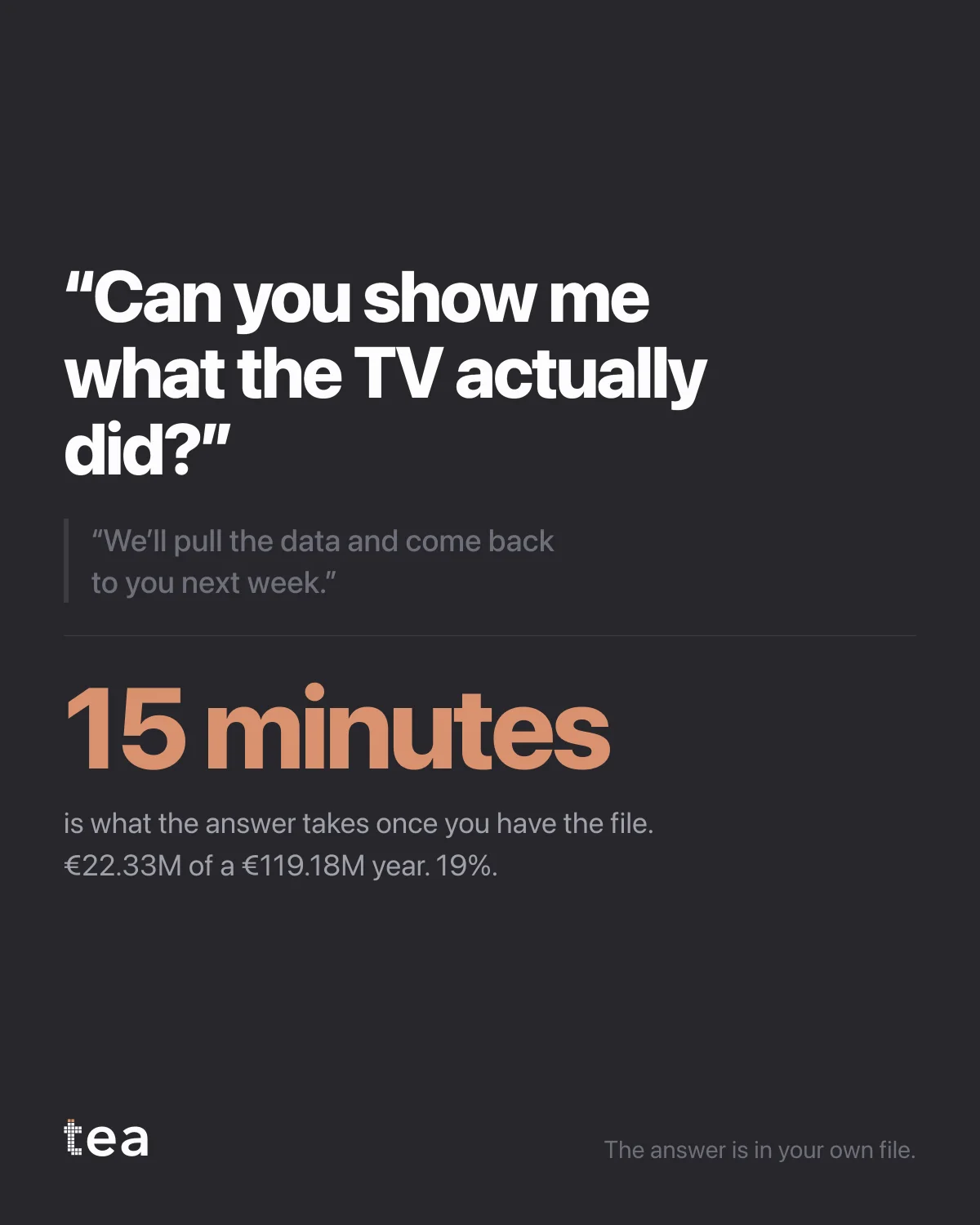
"Can you show me what the TV actually did?"
"We'll pull the data and come back to you next week."
Every marketing director has been on one side of that exchange, and most have been on both.
The delay is not laziness and it is rarely incompetence. It is the shape of the work: the data sits in one place, the model lives with a specialist, the specialist has a queue, and the question arrives in a meeting rather than in a brief. A week is a fair estimate.
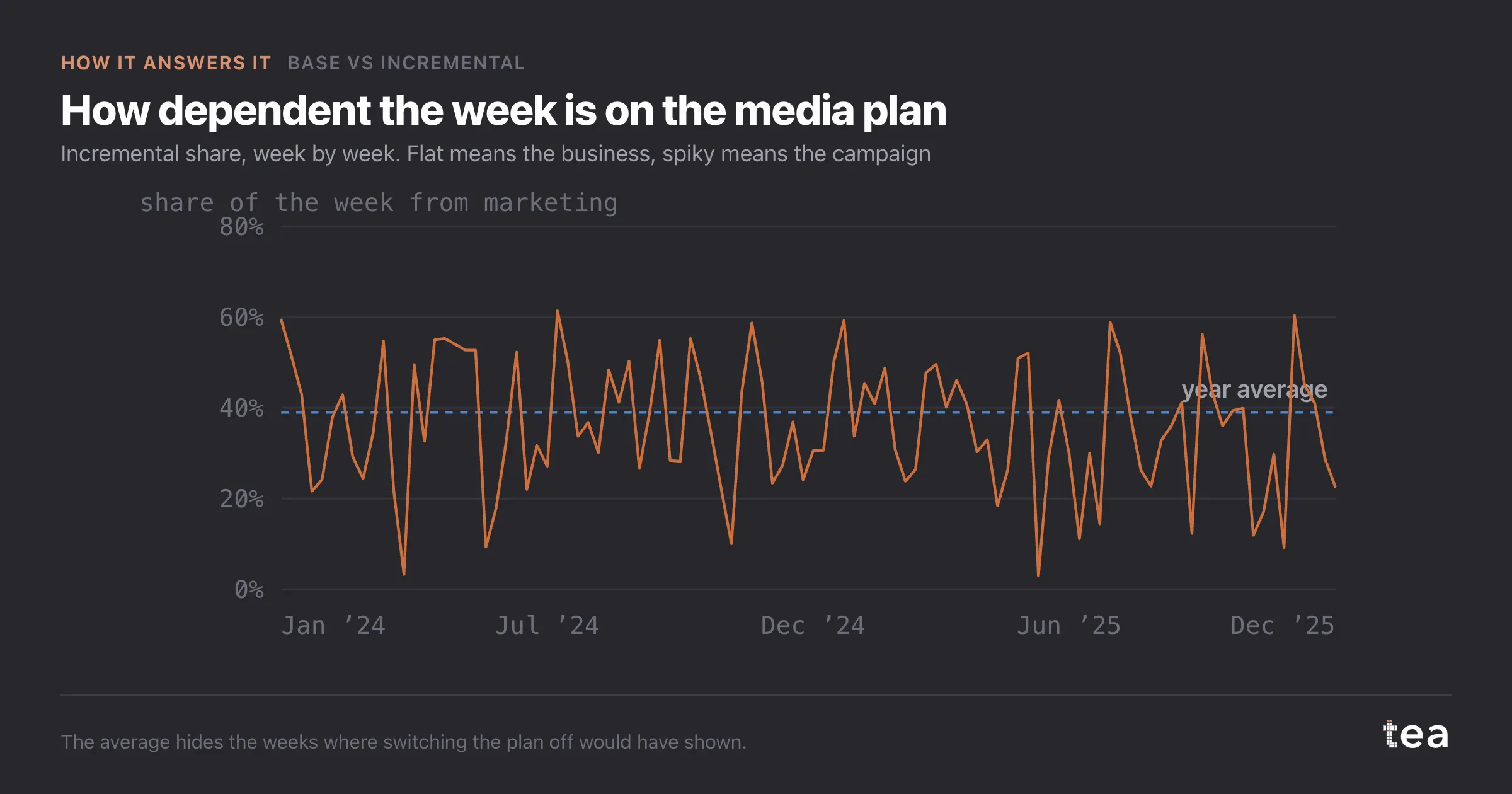
On the demo dataset, the answer takes about fifteen minutes once you have the file. €22.33M of a €119.18M year came from the campaigns. That is 19% of the business, with the other 81% arriving regardless.
What changes when the answer arrives inside the meeting rather than after it:
The question gets asked more often. People do not ask questions they know will cost a week of someone else's time, so the hard ones quietly stop being asked, and the plan gets made on the easy ones.
The answer can be argued with while the argument still matters. A number that lands after the decision is a report. The same number before the decision is an input.
And the follow-up becomes possible. Almost every good analysis question is the second one, not the first: fine, but what if we moved the money, and what happens to the weeks after the flight. Second questions are the first casualty of a one-week turnaround.
The caution is the same as always. Fast is only worth having if the honesty comes with it: the interval, the diagnostics, the note that says when the data cannot support the answer. Speed without those is just a faster way to be confidently wrong.
The answer is in your own file. It has been there the whole time, and the only real obstacle has been how long it takes to ask.
There is a second cost to the week, and it is the one nobody measures. Every delay moves the analysis from the person who has the question to the person who has the tools, and something is lost in that handover: the context, the reason the question was asked, the thing that was going to be decided with the answer.
Closing that gap does not mean everyone becomes an econometrician. It means the first pass belongs to the person with the question, and the specialist gets involved when the answer is surprising or the stakes are high. That is a better use of a scarce skill than being the queue.
Fifteen minutes, once you have the file. The file is usually the hard part, and it usually already exists.
tea, the product
Your file, this question
Fifteen analyses on a CSV of weekly data, with the intervals and the diagnostics shown, and a plain sentence when the data cannot answer. Free while in beta, by invitation.
Request a place in the beta→tea, the product
Fifteen econometric analyses on your own CSV: Base vs Incremental, saturation curves, elasticities, budget allocation. Intervals and diagnostics shown, and a plain sentence when the file cannot answer.
Free while in beta, by invitation.
Request a place in the beta →Liked this? Run it on your own data.
tea runs Base vs Incremental and fourteen other analyses on any weekly CSV, in minutes. Free while in beta, by invitation.