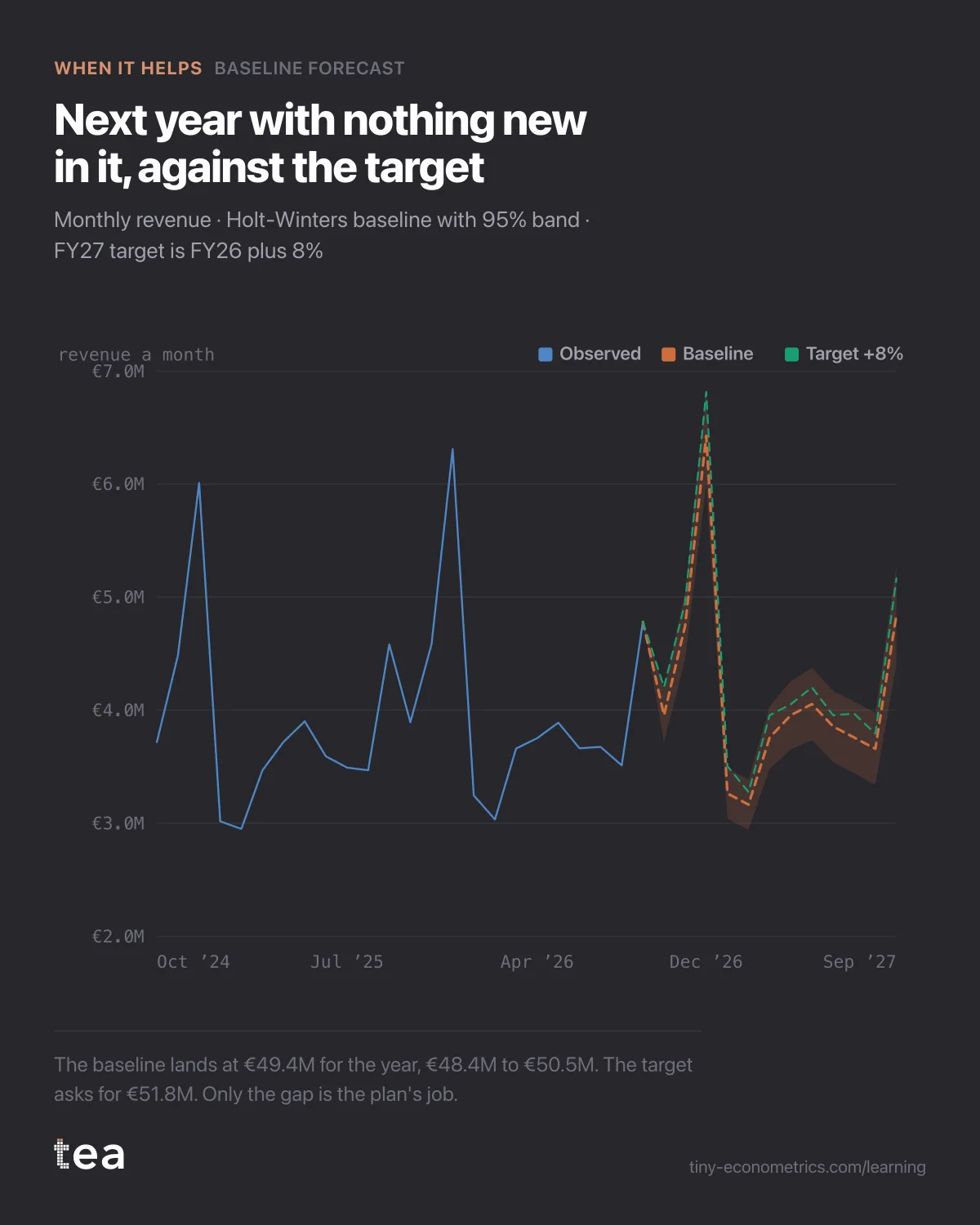
German and Austrian homeware retailer, €48M revenue, 156 weeks of sales, asked how much of an 8% target the new plan had to earn.
A composite case, built from the kind of file we see most weeks. A homeware and kitchenware retailer with 22 stores in Germany and Austria and a webshop that does a little over a quarter of revenue. The fiscal year runs October to September. FY26 closed at €48.0M.
The budget meeting had already produced a number: FY27 is FY26 plus 8%. The question that reached us came from the head of planning, a week before the plan had to be signed off: "Everyone agrees on 8%. Nobody agrees on what the new money has to deliver. How much of it would we get if we changed nothing?"
That is the first question of the Planning Path, and it is usually skipped. A target written as "last year plus X" quietly assumes that next year, left alone, would equal last year. Most businesses do not stand still when you leave them alone.
What the file looked like
156 weekly rows, October 2023 to September 2026. One column of revenue, stores and web together. Store count constant for the whole period, which matters: a new store opening would have been a step, not a trend, and would need handling before anything else.
The three fiscal years read €44.7M, €46.4M and €48.0M. Growth of 3.8% and then 3.4%, without a new store, without a price list rebuild, without any campaign that was not also running the year before. The season was strong and stable: December alone carries 13% of the year, January and February the least, around 6.5% each.
Nothing was missing that the question needed. That is less common than it sounds.
What the baseline did
Baseline Forecast fits a Holt-Winters model: a level, a trend that is allowed to drift slowly, and a 52-week season, each updated by exponential smoothing so that recent weeks count more than old ones. It then projects all three forward unchanged. It deliberately knows nothing about media, prices or plans. It answers one question: where does the series go if the next year behaves like the last ones did.
Before trusting it we held back the last 13 weeks, fitted on the rest and compared. The error on those weeks was 4.1% on average, with no sign of bias: it was over in some weeks and under in others, not consistently low.
The projection for FY27 landed at €49.4M, growth of 3.0% on FY26. The 95% interval ran from €48.4M to €50.5M, that is from +0.8% to +5.2%.
Two things in that interval matter for a budget meeting. Its lower edge is above FY26: on this history, standing still is not the business-as-usual outcome, shrinking even less so. And its upper edge is well below €51.8M: the target is not reachable by momentum alone, not even on a lucky year.
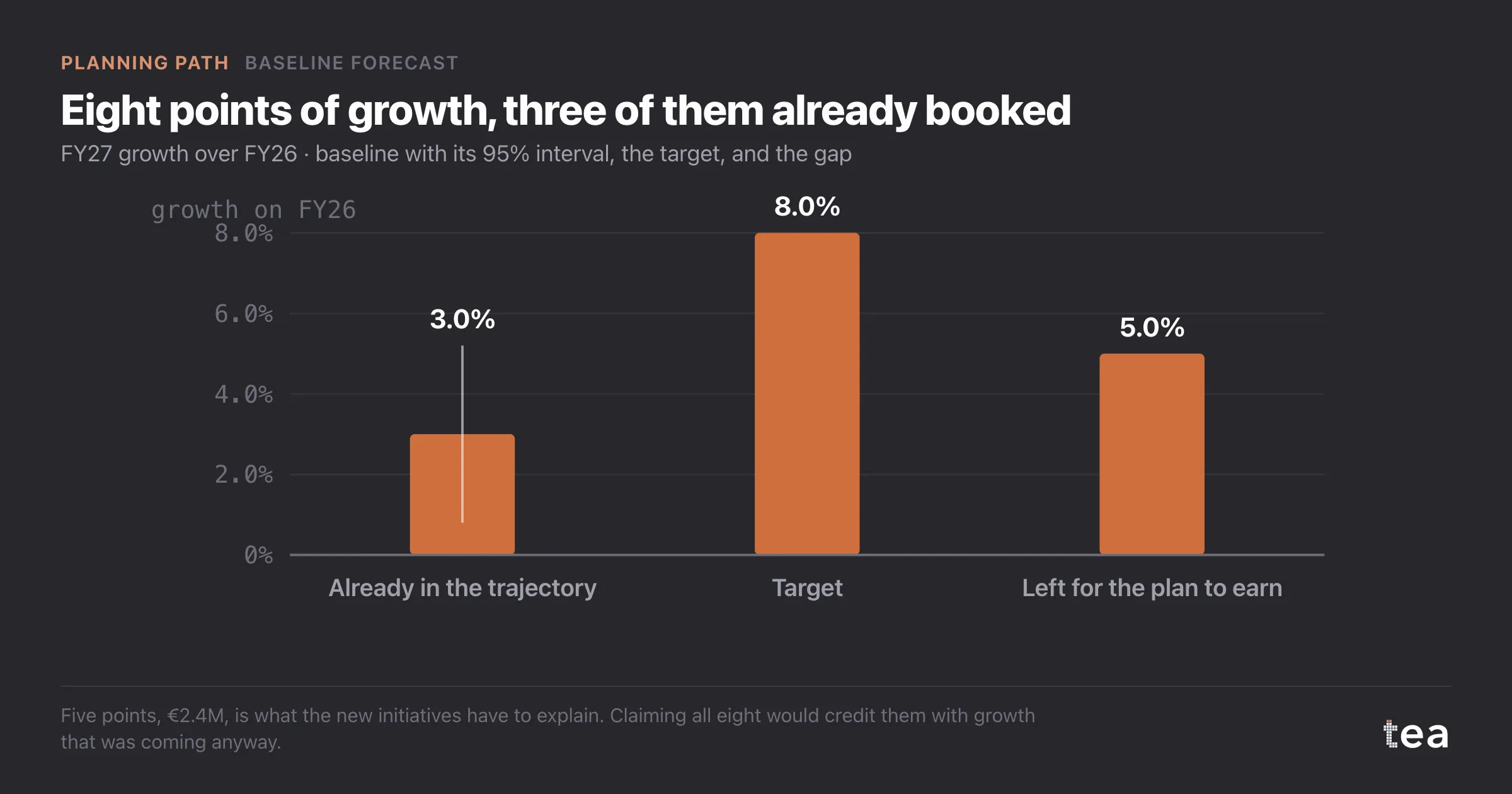
The verdict: it helps, and it moved the plan by 3 points
The target stayed at 8%. What changed was what the plan behind it had to explain.
Before the baseline, the full 8 points, €3.8M, sat on the new initiatives: a loyalty programme, a 20% increase in online media and a range extension into small appliances. Each had a business case, and the three business cases added up, conveniently, to about €3.9M.
After the baseline, the initiatives had to explain 5 points, €2.4M. That did two things.
- The media increase had been justified with a projected return that, re-read against the baseline, assumed it would deliver growth the business was already on course for. Sized against its share of €2.4M, it came down from +20% to +12%, and about €310k of media budget went back into the pot.
- The bonus scheme for the commercial team had been written against "last year plus 8%". It was rewritten against the baseline, so that the team is paid for the gap they close, not for the 3 points that arrive on their own.
There is also a quieter benefit. In twelve months somebody will ask whether the loyalty programme worked. Comparing FY27 against FY26 would have given it credit for the trend. Comparing against the baseline, frozen today, gives it credit only for what it adds. If the business wants to go further and test it with a holdout of stores, the baseline is still the line the holdout is read against.
What it cannot do, said in the same meeting
A baseline is not a forecast of what will happen. It is a forecast of what would happen if nothing new happened, which is a different and more useful thing for a plan. It does not know about a competitor opening next to the Vienna flagship, or about a cold Christmas. The interval covers the kind of noise the last three years contained, not every shock the next one might bring.
It also assumes the trend continues. Three years of 3 to 4% is a reasonable basis for that assumption here; one year of it would not be, and the next post in this thread is a case where the past was not a baseline at all.
The lesson
A growth target is two numbers pretending to be one: what the business does on its own and what the plan adds. Write the first one down, with its interval, before arguing about the second. In this case it was 3 points out of 8, and every decision downstream got smaller and more honest because of it.
The Planning Path
- A baseline forecast for the budget: 3% of the 8% was already coming
- When the past is not a baseline: forecasting after a lost account
- Three-year forecast from 26 months of data: say the horizon out loud (out October 9, 2026)
- Weekly demand forecasting with ARIMA: setting stock on the interval (out October 14, 2026)
- Measuring a one-off event: why one sponsorship cannot be isolated (out October 19, 2026)
- Seasonal indices with a weather control: stop planning on last March (out October 24, 2026)
- Doubling media spend in a scenario: what a simulator cannot know (out October 29, 2026)